728*90

Wednesday, June 1, 2011

Little Rock


Hey, I am still around. Not much to blog about the last 3 weeks. Cold, nasty weather. So, I decided on a rode trip to Little Rock.
Made a quick ride in town to check equipment, then headed to the N. Little Rock River Trail. Rode to Burns Park. Coming back was in the wind. Riding over the Main St. bridge almost did me in, heart rate way up, riding at 5mph. Fast recovery.
Damn, it felt good to be back on the bike!

Tuesday, May 24, 2011

Sizing up Steve Knowlton's cross-country run


A few scattered thoughts on the accomplishments of Steve Knowlton, the Prior Lake man who recently completed a 3,717-mile cross-country run from Washington to Florida. Apologies for the delay on this. I've been meaning to write about Knowlton since he finished his amazing trip last week, but family visits and work obligations intervened.
  • First off, holy shin splints, Batman! According to the article on ABC News, Knowlton ran the equivalency of 142 marathons in 100 days, averaging about 37 miles A DAY (for reference, I averaged about 35 miles of running a week while training for Grandma's Marathon, and even that took a toll on my body). And despite dealing with sickness, fatigue, weather and Lord knows how much leg pain, Knowlton never took a day off from running. I understand how a person can become used to feeling sore all the time when arduous exercise is an everyday routine, but Knowlton's ordeal likely required a pain threshold only few can fathom.
  • Knowlton's cross-country trek was done to raise money for research on Crohn's disease, a chronic inflammatory bowel disease which, according to the Mayo Clinic website, can lead to abdominal pains, diarrhea and malnutrition. Knowlton himself was diagnosed with the disease when he was 17 and his weight plummeted more than 40 pounds. Given the symptoms, Crohn's disease can certainly make healthy living (and exercise) difficult. Kudos to Knowlton for not letting it keep him down. Now 45, he has completed 43 marathons in his life and, obviously, keeps himself in good shape.
  • According to the article, Knowlton got permission from several states to run on the shoulder of their interstate roads in order to keep the trip's distance (in a realtive sense) short. Biking on the shoulder of busy roads can be a difficult ordeal (constant wind of vehicles, fear of cars getting a little too close, etc.). It had to be more than a little tough getting used to running on interstate roads with cars zipping past at 70+ mph.
  • Knowlton supposedly went through a grand total of six pairs of shoes in the entire run, meaning he got more than 600 miles of usage out of each pair. Most running websites say a good pair of shoes can usually get between 300-400 miles of good training on them, depending on form, maintenance and terrain that you're running on. Either Knowlton's uncommonly light on his feet, or he's as stubborn about getting new shoes as I am about buying new clothes.
  • People who saw Knowlton run offered him food, water, shelter and even a new pair of running shoes along the way. This reminds of something Eric and Christie Nelson e-mailed me when I was writing about their bike trip to South America: People have an understanding and respect for the difficulty that comes with doing something like that. Anyone can get in a car or plane and travel cross country, but to do it on foot is something that requires a whole different level of commitment. If that's not enough, Knowlton put himself through this for a good cause.
  • According to the exercise calorie counter website on the side panel of my blog, Knowlton burned an average of roughly 4,200 calories a day on his journey (averaging 6 mph and weighing 150 pounds). Unless Knowlton was feasting on a Michael Phelps-caliber diet, I would guess he probably lost a fair amount of weight during the run. However, I couldn't find any concrete information on that.
  • Like just about everybody else, this is the movie clip that came to mind when I first heard about Knowlton. I don't think I need to say which movie it is.

Knowlton's blog about his run can be viewed here.

Thatched Houses

One of the things I really enjoy about blogging, is the way it has made me really look at my day-to-day world. I have come to see that things which I take for granted, scarcely notice any more, may interest my blogging friends.

Like these pretty thatched cottages which line the main road through our nearest market town, Alford.

I know nothing of their age, but I do know they are very old - just check out how small the white door of the end cottage is. Designed and built when people were built differently from today.

I particularly like this one - just check out the brick work on the ground floor (click to enlarge the photograph) where windows and arches have been changed at some time.

This white one is very attractive - again, see how

small the door is. The sign on the front of the house is a sale board, full details can be found here...

This thatched cottage looks as though it is peering over the hedge.

It was originally a row of shops and cottages, which have now been converted into just one house.

I have tried a few times to get a photograph of the house with the gates open - but no luck.

The white building which you can see next door to it is the rear of the white thatched house in photograph 4 - very cosy!

Alford is a beautiful little market town. I am planning a post on it, so I won't reveal too many details now. It has a working windmill, beautiful old shop frontages, almshouses, a very nice market square, etc and is well known for the regular craft fairs which are held throughout the summer on on most Bank Holiday weekends.

I hope you have enjoyed this tiny taste of what will be on offer.

This is a bonus photograph - it is not in Alford and I have shown it before. It is here simply because it is thatched and I really like it!

Saturday, May 21, 2011

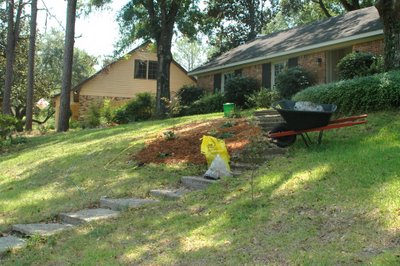
New Garden Bed

This is what I worked on at lunch today.
It looks like a small area in this picturebut at the rate I'm going
I should have this finished by Christmas.
First layer is newspaper.
Second are composted leaves.
Third is composted cow manure.(Bought by the bag)
Last is shredded bark.
I've never done anything like this before.
I don't know how it’s going to turn out.
The hostas and Japanese maple were planted before I started this.Posted by Picasa

Monday, May 16, 2011

So much for reputations


This morning I woke up not feeling very good. Stomach craps, diarrhea, and possibly one or two other things that I didn't notice. I decided to attempt a ride anyway, simply because I can. The opening was extremely sluggish (I later realised this was largely because that was where the wind was coming from), but I started to feel better when I hit the hills. The 14% climb loomed about 5km before Canungra, but strangely, it just didn't feel that hard today, and before I knew it I was through the town and on my way to the big climb of O'Reilly's.


Actually, this climb isn't so bad, the gradient is fairly easy in the early section (even if it does that for 15km), and while I didn't seem to have the motivation to really attack, I still seemed to be making surprisingly good time. Through the false flat, and into the ancient Antarctic Beech forests at the top, then onto the final assault of the mountain, the last 7km of the climb, where things get a little steeper in parts. Strangely, the steeper it got, the better I felt. The final act of this one is a steep section that the locals refer to as "Big Bertha" -- they claim it's 25%, but I think 15% is more realistic. Either way, once I got sight of the top, I was able to power over it, and crest the summit. After applying sunscreen, it was time for a descent, back into the town of Canungra, where I had a decision to make -- just how would I go about finding the extra miles to make up a century.
To the north loomed Mt Tamborine -- the road to get there was once rated in a magazine as one of the ten hardest climbs in the country -- and I suspect the person who wrote that article wasn't doing it as their "second" climb. After giving it much profound thought (i.e. "Ahh, sod it!), I decided to have a crack at it. The gradient on the road out of Canungra is 9% (according to the signs). Shortly after the Mt Tamborine turn-off, a sign says 12%. Around the next corner, another sign says 14%. That's the way it went for the entire climb (which is, in reality, only a few km long) -- 13%, 12%, the final assault of 14%. Actually, the final assault can be a problem -- it's a single lane section controlled by a set of lights at either end. If one is to do it without stopping, you can't afford to mess around.

I thought about attacking it, but that thought lasted only as long as it took me to feel the lactic acid of two mountains in my legs -- I opted for clinical rather than aggro. I must have made it look easier than it felt -- at least that was the impression I got from two motorcyclists at the other end. Now I could see the top, Mt Tamborine, this climb with the such a vicious reputation, was about to crack. I shifted upwards and finished the job with a traditional victory salute (a solitary finger raised). It was done. After a beautiful lunch on the mountain, and a screaming descent on the other side with sweeping views that lasted forever, I had one final enemy -- Wongawallan. I don't understand this climb, it's not big (only 130m), and it doesn't appear steep, but it always poses a problem. I'm not the only one who says this incidentally.
There's no point riding Wongawallan to survive -- you won't. You must attack, take it as a personal insult that this petty climb at the foot of Mt Tamborine would dare get in your way, it's the only way. By this stage my legs felt like lead, but Wongawallan, too, fell under the on-slaught. A few other foothills to Oxenford, and the edge of suburbia -- now I realised, that for the first time today, I was about to have a tailwind. After laughing in the face of a moron on Hope Island, who took about five years off his life by getting really angry about the sight of a bicycle on the road, before realising that either way, he was only going to go as fast as the rest of the traffic, I returned to Paradise point and charged down the coast.
Around Runaway Bay I had a minor problem -- I felt as though I needed to eat a muesli bar, but I'd eaten way too much on Mt Tamborine and didn't think I could eat one without throwing up. Then I began to realise that to do a ride like this, after the start I'd had, was something I may never do again. I was inspired, I shifted up a gear, and took off. It wasn't long after this that I had the pleasure of picking my way through the traditional Sunday afternoon gridlock on the Gold Coast, passing hundreds, possibly thousands of cars that were stuck (suckers!). I suddenly forgot that I was tired, although after I made it back home, I suddenly remembered again.
Beyond that there is little to tell, but if anyone is still reading this, I'd like to know something. I thought diarrhea was supposed to weaken the sufferer, not suddenly make them stronger and able to go further. How did this happen?

Sunday, May 15, 2011

Flat and Walk


It was a pretty nice day for a bike ride yesterday. Just a little windy (10-20mph from the WNW). I needed to get out and ride - been off the bike for a week! Loaded up the road bike and headed for the Wabash Trace Trailhead Park. The parking lot was almost full. Must be lots on the Trace (though I had heard about trees over the trail). My destination was the Trails Center.

Lots of folks out on the trails. Stopped at the river boat ramp parking lot. Check the river level and visited with a couple mountain bikers.

Head-wind slowed me down a bit. Worst was the last mile from Penny's to the Trails Center. Ready for my rest, drink, and granola bar when I got there. Knew the Trail Center would not be open (Holiday), but it was a good place to turn around.

Great to have the tail wind most of the way back. Coasting much of the way. Having a great ride when I flatted. I heard it, not sharp crack, more of a whimper. Must have been some glass on the trail into the dirt there at the pumping station (E. Manawa Rd just off Rt 92).

Knew it was about 3 miles to the car. Debated and decided to change the tube. Got everything torn apart and ready to apply the new tube. I could not my CO2 inflater to work. It would not put any air into the tube. Emptied on inflater. Of course, there was no one on the trail that stopped with a pump. I ended walking the bike 3 miles back to the trailhead and my car.

As I was walking along the trail, I noticed LOTS of glass shards on the trail. Think there have been may idiots pitching glass (beer bottles?) from the car, at the trail and/or bike riders.

Will be at the bike shop to get the tire repaired and the inflater checked out (or I will have to bring a pump on the road bike).

Friday, May 13, 2011

The Spanish Layde's Love

Today I bring you a tale of romance, honour, and sadness.


Will you hear a Spanish Lady,
How an English man she woo'd.
Tho' he held her as his captive,
Ever gentle was his mood.
Tho' by birth and parentage of high degree
Much she wept when orders came to set her free.
"Gallant captain, shew some mercy
To a lady in distress,
Leave me not within this city,
I shall die of heaviness;
'Tis an empty mockery to set me free
While my heart in prison still remains with thee...etc


Sometimes you don't have to travel far to find a good story. This tiny, greenstone and chalk church is about two miles from our village. It is surrounded by horse paddocks, with a manor house right next door, and a handful of cottages dotted around. The church is still a place of occasional worship. Luckily for me it is left unlocked, so I was able to explore it at my leisure.


This is one of the tales it has to tell...


The year was 1594 when a force of 150 ships and some 8000 soldiers set sail from England, their aim was to lay siege to the Spanish Navy in the port of Cadiz. Among the soldiers was Sir John Bolle of Lincolnshire, a captain in the army of the Tudor Queen Elizabeth I. John Bolle was 34 years old, handsome, and chivalrous, a gentle man.


image of Sir John Bolle borrowed from flickr


The Spanish fleet was destroyed and the town was taken.

Hostages were seized, and among those prisoners assigned to the care of John Bolle was an exceptionally beautiful young woman of noble birth and great wealth, thought to be Donna Leonora Oviedo.

During the 13 days of the siege John Bolle treated her with such courtesy and kindness that she fell deeply in love with him, although, (so the story goes) he remained faithful to his wife.

Upon her release, beautiful Donna Leonora threw herself at his feet, professed her love and begged to be allowed to travel with him to England. John Bolle explained that he had a wife and family waiting in England.

Heartbroken, Donna Leonora presented him with many gifts, including jewels for his wife, a bed and bed coverings, caskets of plate, and a portrait of herself wearing a green dress and black veil. Donna Leonora then took herself off to a nunnery, where she spent the remainder of her days...

This sad story has been retold in the ballad 'The Spanish Layde's Love' which was composed shortly after the fleet returned...(see top tab).

John Bolle and his family lived at Thorpe Hall in Louth...much altered and added to over the centuries.


Image of Thorpe Hall borrowed from allseasonsuk.co.uk


The gifts which Donna Leonora showered upon Sir John were brought back to Thorpe Hall. Unfortunately the portrait was sold many years ago, but Louth museum purchased a beautiful red velvet coverlet, with silver lace borders, which is said to have been among the gifts. Sir John's family is said to have felt her presence at the Hall and his heir, Sir Charles Bolle always had an extra place set at the dinner table for her.

It is still said that the 'Green Lady' haunts Thorpe Hall, she is supposed to sit near a particular tree in the grounds, waiting for her love.

Sir John Bolle died in 1606, aged 46 years. He is buried in this little church, along with other members of the Bolle family.

This marvellous monument depicts Sir John and his wife, their three sons and five daughters.

The manor house next door was built in the mid 1500's, it was the home of the Bolle family until the much grander Thorpe Hall was built.


St Leonard's Church has its origins in the 10th century, although there have been many alterations and additions since. These days it is suffering badly. Great chunks of plaster have fallen from the walls, green damp marks are everywhere, there are lots of bird and bat droppings inside and it feels neglected. I'll post about it another time.