728*90

Friday, October 3, 2014

Point Lookout

I’ve had Point Lookout State Park in Scotland, Maryland on my list of places to visit/camp for a while now.  The problem is that it is another one of those ‘too far to travel just for the weekend’ places since it would take us about 3 hours to get there in the Phaeton.  So, when we switched gears and went to Shenandoah River State Park yesterday, we decided to take a drive down to Point Lookout today to at least check out the campground.  As it turns out, we did much more.

Driving distance to Point Lookout State Park from Vienna, VA is 180 miles (288 km) round-trip;
about 2 hours each way in the car — if the traffic cooperates.
the map on the right shows some of the other places of interest nearby.

We got a late start, leaving the house just before 10:00a; but we made good time since traffic was light and there wasn’t too much stop-and-go as we drove state routes through one small town after another.

When we arrived at the campground, we found the office locked up and a sign for campers to use the code to open the gate.  Since we didn’t have a code, we parked the car and went for a stroll through the various loops, looking to see which sites might be better than others.  The camping season is from April through October, so this time of the year, the only loop open is Tulip (50A FHU), which was mostly deserted.  Located in the wooded area, almost any of these sites would do for us, but the area we really liked was Green’s Point, which overlooks Lake Conoy.  The sites are 30A electric-only;  very long and have a nice pad on the water with a picnic table.  As it turns out, the particular sites we liked are already booked for the time frame that would work for us this spring, so we may have to back-burner this park until we retire and can be more flexible with our dates.

Site 98 (left top/bottom) on Green’s Point loop would easily work for us.
the pier makes is easy to participate in water activities.

Our campground recon completed, we headed back out to Point Lookout Road and drove to the tip of the peninsula, which is located at the confluence of the Potomac River and Chesapeake Bay.  Despite the stiff breeze coming off the water, we had our picnic lunch at one of the tables near the now-defunct lighthouse.  So glad the sun was out to keep the chill at bay.

Mui’s holding on to me so that the wind doesn’t carry me off :-)))

After lunch, Mui read his newspaper while I wandered around, reading the markers posted nearby, starting with the one about the Point Lookout Lighthouse. Built in 1830, the beacon was decommissioned in 1965.  Rumor has it that it is haunted (cue the Twilight Zone theme).  Meeting the resident ghost will have to wait until another time, however.  The site was locked today and I had to be satisfied with a few photos from my side of the fence.  Luckily, I had my Canon G12 with me, so I could get it through an opening in the fence line for some halfway decent photos in the harsh mid-day light.

The Point Lookout Lighthouse and the smoke house (right) that the keepers used.

The land on which the park sits is steeped in Civil War history.  Where we had our picnic today once stood Hammond General Hospital, a massive structure with 16 wings radiating from an open central area.  It was built in 1862 and could accommodate 1,400 patients.  Both Union and Confederate soldiers were cared for at the hospital.

The massive structure was set on piles several feet tall.  Well over 500 feet (152 m) in
diameter, All but one of the wings were patient wards.
[photo of an image on the marker; sorry about the cracks]

The hospital closed in August 1865 and the entire structure was demolished.  Today, all that remains of this massive structure is a timber outline with a marker in the center.

This marker was installed to mark the general location of the hospital.

On our way out of the park, we stopped to read other markers along the road; some Civil War related, others not.  One such signage described the appalling conditions of the "Contraband Camps” established at Point Lookout — contraband being the word applied to the thousands of slaves that escaped from captivity in the South to liberty in the North.

Some of the residents of the Contraband Camps later found jobs at Point Lookout as military
service staff or laborers, jettisoning the bonds of slavery for the government payroll.

At the time the Army leased the land at Point Lookout to build the hospital, there was a resort here that was built in 1860.  The marker at the site didn’t provide much information about it, except to state that it burned down in 1877 and that another resort replaced it in the 1920s.  All that remains of the second resort are a couple of rusty gear wheels from the power plant that provided lighting for the resort building and power for the water treatment plant.  The resort building was torn down in 1989 due to shoreline erosion.

Top left: postcard image of the resort from its heyday in the 1930’s.
top right: Mui checks out the beach near the resort site.

Just outside the park we checked out two more sites, both honoring the Confederate dead associated with the prisoner-of-war camp that was established at Point Lookout by the Union following the Battle of Gettysburg (1863).  By 1865, there were 20,000+ Confederate soldiers imprisoned here.  By the end of the war, 52,000+ men had passed through; 3,800 of them did not survive the camp.

First, we stopped at  the privately-funded Confederate Memorial Park.  From what I gathered from the signage, it was founded by the Point Lookout Prisoner of War Descendants Organization who wished to “erect a memorial plaza that would be free of government interference and restrictions.”  It’s their intent that the memorial will list the additional documented names of those who died at the camp whose names are not listed on the monument in the adjacent federal cemetery (our next stop).

The flags that circle the plaza belong to the states that seceded from the Union
during the Civil war.  The flag in the center is the Confederate Battle Flag.

Clockwise from top left: illustration from  a POW journal depicting the prisoners cooking rats to fend off starvation ♦♦ glimpse of the memorial plaza ♦♦ historic marker ♦♦ located in the base of the statue, this cauldron was used to prepare food for prisoners — it was known as the “bean pot” ♦♦ The bronze statue represents a Confederate soldier; he is facing south — towards home.

At the Confederate Cemetery next door, we found two monuments — one erected when the federal government began maintaining the property in 1910; and an earlier one that was erected by the State of Maryland in 1876.

The Confederate soldiers and sailors interred here were originally buried in two cemeteries that were near the prisoner-of-war camp.  After the state removed the remains from those sites in 1870, the individual graves could not be identified; hence they were buried in a common grave at this site.

The marble monument (left) erected by the State of Maryland and the 80-foot (24 m) tall
granite obelisk erected by the veteran’s administration to mark the common grave.

Despite what the signage at the Memorial Park indicated to the contrary, we found
the Confederate Battle Flag flying at the cemetery.

Thus we brought our Sunday outing to a closure.  Although the breeze coming off the Chesapeake chilled a day otherwise filled with sunshine, we enjoyed exploring places new to us.  In the process, we learned a bit more about the Civil War history that is strongly intertwined with the lives of so many who call the area home.

We ended the day on a really nice note when we spotted a bald eagle flying overhead.

Not bad for a fully-zoomed point & shoot photo.

What more could we ask for?  Oh yeah — RETIREMENT!  But that will come soon enough.

P.S.  If you’d like to see full-sized versions of the photos making up the collages, click here to go to my online gallery.

Monday, September 29, 2014

Speak Softly...

... and annihilate evil with... well, could there be anything more effective than Mr. Stick?

Thursday, September 25, 2014

CALLING GARDEN PRODIGY


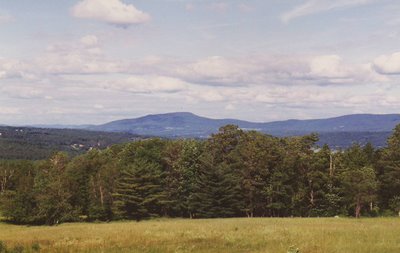
When you look at this photo the conifers might tell you that it wasn’t taken in Texas – in fact it wasn’t taken in this century. A woman named Pam snapped the shutter in June of 1993, as she looked out on the Vermont countryside from the Tearoom of the VonTrapp estate. Pam was part of a group of gardening friends who were touring New England, but not as part of a garden club or a horticulture class. Back in those pre-blogging days, they’d all met on the Prodigy garden bulletin board, where they found soulmates – other people who were obsessed with perennials, bulbs, flowering shrubs and creating personal landscapes.
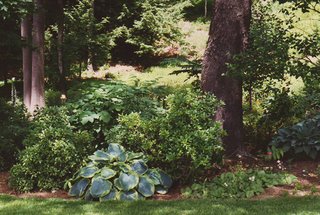
The Prodigy gardeners went to Readsboro, Vermont where these Hostas graced the grounds of North Hill. Garden authors and partners Joe Eck and Wayne Winterrowd started this garden in 1977 and thirty years later, they’re still holding open days for groups and fundraisers.
I was one of those long ago perennial maniacs, going online as Kat in N-IL whenever I had time to spare. Despite having only plain text to express our thoughts, slow response times, single phone lines with dial-up, and no way to post a photo or a drawing, it was addictive and exhilarating. Since I couldn’t meet with the others in New England, the garden at North Hill and the Von Trapp estate came to me in photos sent around the country after the trip.

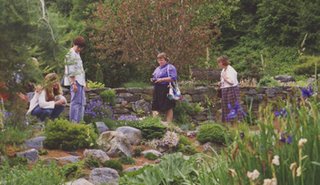
This is also from Vermont - I think it's at Cady's Falls Nursery in Stowe. We never met in person so I can’t even put names to the faces, but loved their words and wonder where they are and if any of them are now garden bloggers, too.


Shout out to all you Gardeners from the Prodigy bulletin boards – Niko in Norwalk, Connecticut, Allen in Linwood, New Jersey, Marion from Waterbury, Vermont, Denise in Minnesota, Ellen & Deb from Illinois, Margaret in New York, Pam in Mechanicsburg, Pennsylvania, Bargyla in San Diego, California, Don from Saginaw, Michigan, Joyce in South Carolina, Nancy from Norcross, Georgia and all the others - I hope you’re still in the garden!

Freightliner, and Allison, and Cummins, and Onan … Check

22 March

When we purchased our “gently-used” Phaeton, we had everything checked out before plunking down the purchase price. That was in May . Granted we didn’t get to use the coach much last year, but we hope to change that this camping season. So, with that in mind, we decided to get the annual inspections done on our Freightliner chassis, Cummins engine, Allison transmission, and Onan generator.

At first, we were going to take the rig to two different service centers. Then we found out that the Johnson Truck Center in Gainesville, Virginia was qualified to handle all of our inspection needs. Well, the decision became a no brainer at that point.

If you peek into the first bay, you’ll see what we saw.

We dropped the Phaeton off on the 15th. A few days later, we received the news that all was well — with the exception of a few warranty/recall items that were quickly taken care of. One part had to be ordered, so we left the rig at Johnson over the weekend. We were notified this morning that the coach was ready for pick up. All I can say is … WOW! That’s the fastest we’ve ever been in and out of a service center. And it certainly wasn’t for lack of business at Johnson; the service bays were busy with ongoing work and the yard had rows of vehicles (including a couple of RVs) waiting for their turn to be serviced.

A busy place to be sure.

“We’re RV friendly,” Jeff, the branch manager told me when I met him this afternoon. I would agree. The quality workmanship, and excellent customer service, including prompt communication, earns the Johnson Truck Center two thumbs up from us.

With the toad hooked up, we were soon on our way. Next stop — the Fannon station where we filled up on diesel at $3.87/gallon. Not bad for this area! Then, onto the storage lot, where we put the coach to bed. Now that she’s greased, lubed, and oiled, and all her fluids are topped off, the Phaeton is ready for her first outing of the season. But first, Mui has a few maintenance things he wants to take care of this weekend. And, I want to take some of the stuff we took out of the coach at the end of the last camping season back and start getting organized again. But the weekend after that we’ll definitely be going camping.

This is how you replace the water filter.

By the time we were on our way home, it was past 6:30p. With stomachs grumbling, we decided to have our weekly date-night a few days early. We could have gone someplace new, but decided to go to the Copper Canyon Grill again. This time, we shared a Caesar side salad, and split Mary Ellen’s Crabcakes. I have no idea who Mary Ellen is, but her crabcakes were delish; as were the sweet glazed carrots and orzo rice with a southwestern twist. We topped off our meal with an excellent Key Lime Pie. The dessert was rich and creamy, and very tasty, and there was enough to not only split, but also bring some of it home for tomorrow night’s dinner.

Yummmm!

Tuesday, September 23, 2014

12 months ago today...


It was on this day in 2006 that I added another dimension of self-sufficiency to my cycling armoury.
Traditionally I had never been mechanically inclined. Apart from something simple like changing a flat tyre or applying some lube to a chain, my solution was always "take it to a bike shop". In fact, when I broke a gear cable in 2004 at Wilson's Promontory on a bike tour, I simply rode with only one gear on the front for two days until I got to a bike shop to do the repair.
These days I'm more inclined to do it myself, but it took something to bring out those instincts. That something was breaking a pannier rack (which basically held my full touring load) in New Zealand last year, and having to do an emergency repair on it. The positioning of the break (right near the frame mount) meant that simply taking it to a service station and getting it welded was impractical.
In short, I needed to hold it together for 600km* to get to a bike shop (including 100k of dirt), where I could obtain a replacement. It was on February 24, 2006 that I made it -- although when I crested the final climb of Mt Cargill and prepared for the final descent into the city, I wasn't thinking about that. I was merely thinking of negotiating a particularly treacherous wind without being blown into Otago Harbour. I'm as proud of surviving that as I was of surviving the 600km to get there.
* It would have been much less than 600 km, had I not been hammered by a headwind en route to Cromwell which delayed my arrival until the bike shop in that town had closed. Interestingly, the tail light mount on the replacement that I eventually bought didn't stand the test of time so well, and snapped off the new rack at Springbrook shortly after my return. I built my own replacement from otherwise useless spare parts, which is still holding together.

Bay Area Tropical


A stunning Heliconia schiedeana flower. This species is one of the cold-hardiest heliconias available.

Sunday, September 21, 2014

Autumn on Mt. Sophie


Mt. Sophie is probably my favorite place to view fall colors, and each year during the peak of fall color season I make many trips to this area to photograph the changing leaves. This year wasn't as "good" as most years, but was still quite beautiful. There is an old fire tower at the summit of Mt. Sophie which provides for some amazing view of Trout Lake, Swamp Lake and the surrounding Maple ridges.

During one of my morning ventures to Mt. Sophie I was accompanied by my friend Roger and his cousin from California. The morning that the three of us hiked up to the summit we walked through a beautiful light blanket of snow that had fallen during the night. The freshly fallen Maple leaves resting on the snow made for an interesting contrast in color.

(Above: Morning fog over North Lake)
(Below: A blustery, snowy morning over the forest)

(Below: Morning steam over North Lake as I drove up the road to Mt. Sophie)

(Below: "Sky-blue waters" - Clouds reflected in the waters of Trout Lake)